- CFD, Fluid Flow, FEA, Heat/Mass Transfer
Applications in FEA
FE Analysis
Topics Related to FEA, Dynamics and Fatigue
Table of Contents:
Project Chrono
It is an open-source, multi-physics simulation engine designed to model the physics-based dynamics of large-scale mechanical, robotic, and granular systems. The platform is highly modular providing several domain-specific libraries such as Chrono::Engine (foundational core middleware handling basic physics, constraints, and collisions), Chrono::Vehicle (template-based package for modeling wheeled/tracked vehicles and deformable terrains), Chrono::Sensor (to simulate complex sensors like LiDAR, cameras, GPS, and radar to test autonomous driving software, and PyChrono (Python wrapper enabling pairing with machine learning).Shape Function
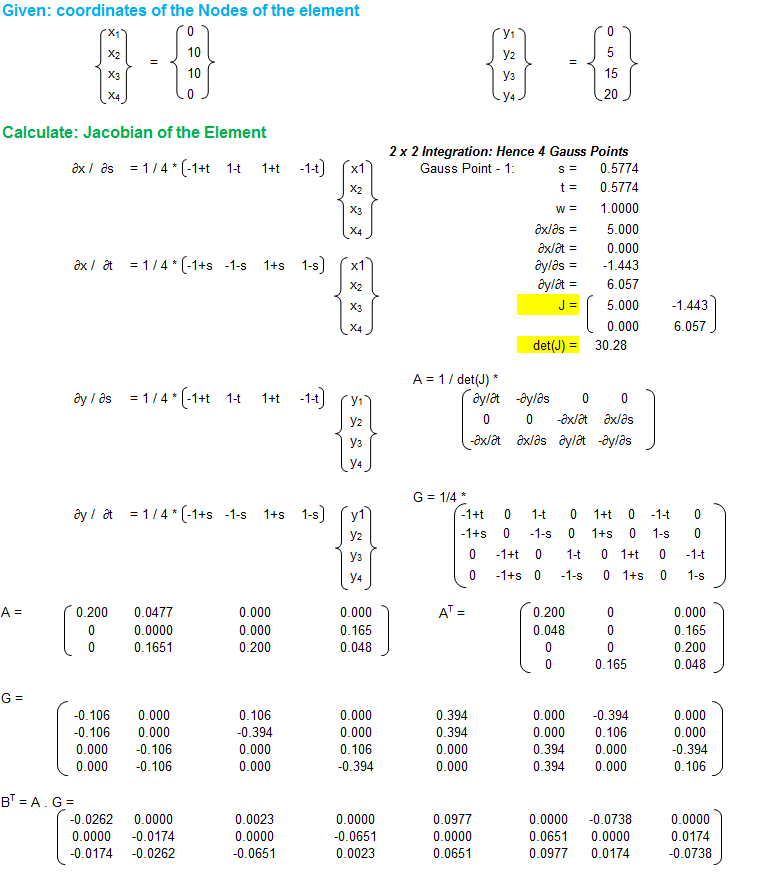
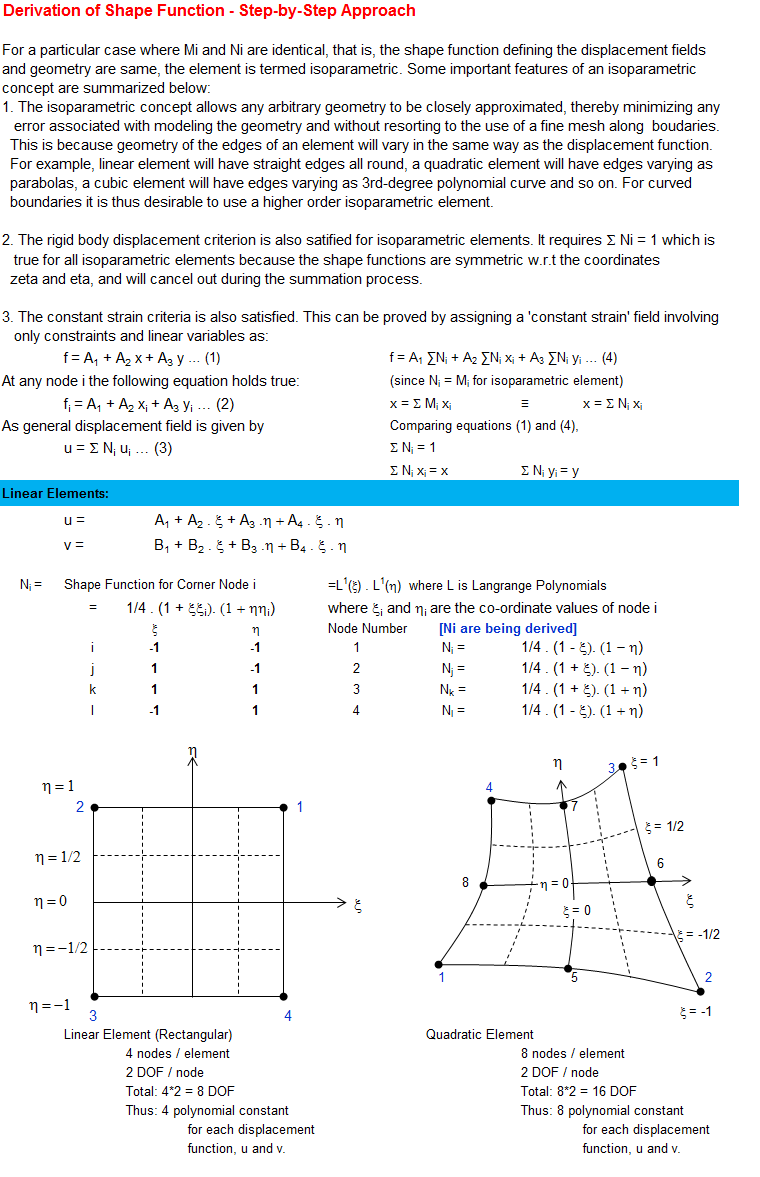
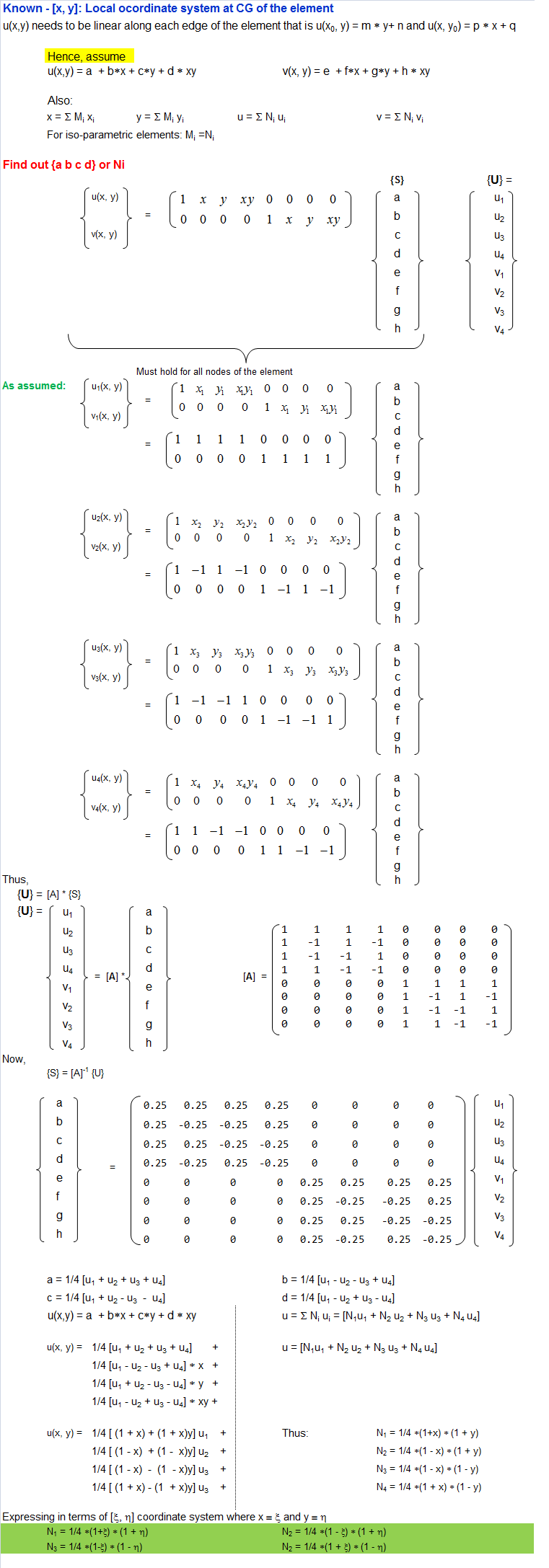
Shape functions are ubiquitous concept present in every Finite Element simulations of elastic components. This is an attempt to demystify the concept of shape functions by describing the step-by-step approach to get the function as they are used. The work is based on concepts presented in Zienkiewicz and Bathe where the authors have been [a bit extra] succinct in the textbook to describe the way shape functions are evolved.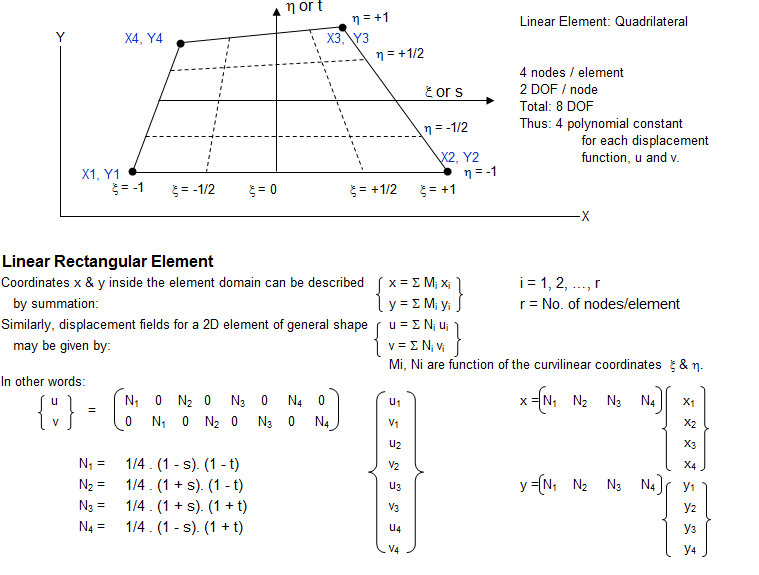
OCTAVE Scrip for Matrix Inversion
% Script for matrix inversion
A =    [ 1    1    1    1   0    0   0    0,
	 1   -1    1   -1   0    0   0    0,
	 1   -1   -1    1   0    0   0    0,
	 1    1   -1   -1   0    0   0    0,
	 0    0    0    0   1    1   1    1,
	 0    0    0    0   1   -1   1   -1,
	 0    0    0    0   1   -1  -1    1,
	 0    0    0    0   1    1  -1   -1
];
inv(A)
Shape Function Example for 1D Quadratic Element
Obtain shape functions for the one-dimensional quadratic element with three nodes using local coordinate system -1 ≤ x ≤ +1.
 O--------O--------O
 1        2        3
-1--------0--------1------->x
Using shape function, any field (such as displacement, strain, stress) inside the element can be expressed as u(x) = ΣNiui where i = 1, 2, 3 for 3 nodes of the quadratic element. At nodes the approximated function should be equal to its nodal value. Thus:
u(-1) = u1, u(0) = u2, u(1) = u2From 3 points, we can fit a polynomial of order 2 that is a quadratic polynomial with 3 coefficients. Hence,
Let N1 = a1 + a2 * x + a3 * x2
N1(-1) = 1, → a1 - a2 + a3 = 1
N1(0) = 0, → a1 = 0
N1(1) = 0, → a1 + a2 + a3 = 0
Thus:a1 = 0, a2 = 1/2, a3 = -1/2
Finally,N1 = 1/2 * x *(x - 1)
Similarly,
Let N2 = b1 + b2 * x + b3 * x2
N2(-1) = 0, → b1 - b2 + b3 = 0
N2(0) = 1, → b1 = 1
N2(1) = 1, → b1 + b2 + b3 = 0
Thus:b1 = 1, b2 = 0, b3 = -1
Finally,N2 = x *(1 - x)
Similarly,
Let N3 = c1 + c2 * x + c3 * x2
N3(-1) = 0, → c1 - c2 + c3 = 0
N3(0) = 0, → c1 = 0
N3(1) = 1, → c1 + c2 + c3 = 1
Thus:c1 = 0, c2 = 1/2, c3 = 1/2
Finally,N3 = 1/2 * x *(1 + x)
The content on CFDyna.com is being constantly refined and improvised with on-the-job experience, testing and training. Examples might be simplified to improve insight into the physics and basic understanding. Linked pages, articles, references and examples are constantly reviewed to reduce errors, but we cannot warrant full correctness of all content.
Copyright © 2017 - All Rights Reserved - CFDyna.com
Template by OS Templates